Call the number you saved before money leaves the video call
A video call that shows a relative and asks for money still needs a callback on a number you already saved, or a check with another relative.
“Your child or grandchild has been in an accident. Send money now.” That line is one of the examples in a warning about video calls that pretend to be a relative.
The face on the screen can look very much like someone in the family. So can the voice. The caller can take photos, video, and a voice that were already posted in public, then place a video call, claim to be that relative, and bring up something urgent. Tools that paste a face onto a video and imitate a voice, often called deepfake and DeepVoice, can make a picture and a sound real enough that the listener thinks they are talking to a real person. Seeing the face, or hearing the right voice, on a video call does not prove the person on the line is your relative.
The decision is the number you already saved
Hang up. Then call that person on a number you already saved, or ask a different relative. The police of Bảo Lâm 3, in a warning published on the Lâm Đồng provincial police site on 25 August 2026, also suggest a family password, or a question only people in the household know. Use that question after you have called the saved number. The question does not stand on its own.
The household in the next paragraph is a way of following that advice. It is not a case this newsroom recorded.
A mother hangs up the video call, dials her child’s saved number, and keeps talking only when she hears the phrase the household agreed on.
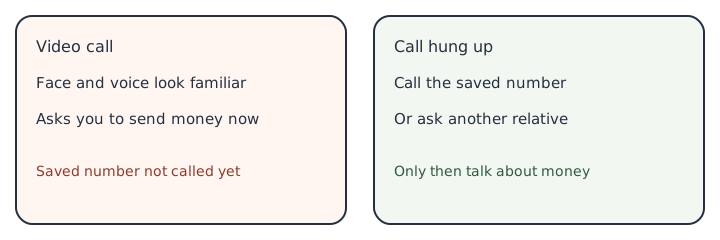
The diagram only shows that order. It is not a recording of a call.
The same page lists other lines a caller may use: a bank account is locked, the person is at a police station or a hospital, a friend is in trouble and promises to pay the money back. Keep those lines as warnings, then go back to the saved number.
A voice sample, and who receives the money
Vietnam’s Ministry of Public Security, in an article dated 8 September 2026 on 25 online scam scenarios for 2026, places this method in the group that uses artificial intelligence to fake images, video, and a voice. The article says the caller impersonates a relative, a friend, or a boss at work in order to borrow money or demand an urgent transfer. Some calls only collect a sample of the voice, for a later impersonation. A short conversation that sounds very much like your child can still be that collection call.
In the same article, the police advise you not to send money until you have checked who will actually receive it, and not to give out personal information, a password, or an OTP. An OTP is the code sent to a phone to confirm a transaction. The Bảo Lâm 3 warning draws one more line. It says the police do not ask members of the public to transfer money by phone in order to “verify an account” or “prove you are innocent,” and they do not ask for a bank password.
If the money has already left the account, the Bảo Lâm 3 page says to call the bank at once and ask for help with the transaction, keep the phone number, the receiving account, the messages, the photos, the video, and the transfer history, then report to the nearest police station.
A face, a video, and a voice posted in public can be taken and used to build the call. The same page says to limit posting those, along with identity papers and account details.
Primary sources
- Bảo Lâm 3 police — Watch for scams that use AI, deepfake, and DeepVoice — published 25 August 2026 on the Lâm Đồng provincial police site. It describes video calls that fake a relative, hanging up and calling a familiar number, and a family password.
- Ministry of Public Security — 25 online scam scenarios for 2026 — published 8 September 2026. The deepfake group includes impersonating a relative to ask for a transfer, and calls that collect a voice sample.