Keep a chatbot's price only when the seller's page shows it
Open the maker's or seller's page, and keep a price, a capacity, or a buying line from a chatbot table only when that page says the same thing.
You ask which rice cooker fits a family of four. What comes back is a table, not a product link: 1.8 liters, a price of about 1.2 million dong, and a line that says to buy it. The editors built that table for this article. It is not the output of a chatbot that was run, and it is not a cooker on sale.
A price, a capacity, or a buying line is worth keeping only after you open the maker’s page or the seller’s page and find the same words there.
Open the page, then keep a line
Suppose the page you just opened says this: an electric rice cooker, capacity 1.8 liters, listed price 1,490,000 Vietnamese dong, warranty 12 months at the service centers on the maker’s list. The page has no line that says to buy it.
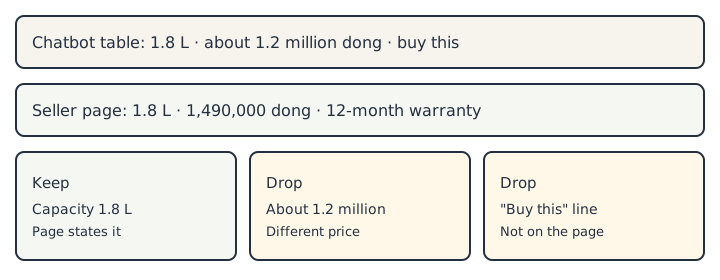
Read the table one line at a time and ask whether this page states that line.
The capacity of 1.8 liters is written on the page. Keep it. You are looking at the page, which is a different reason from the chatbot having said it first.
“About 1.2 million” does not match the listed 1,490,000 dong. Drop the chatbot’s figure. The figure you compare is the one on the page, and even that figure can still differ in the cart or at another seller.
The line that says to buy it is absent from the page. The chatbot supplied it. Drop it.
The extra warranty line is the place to stop
In this same constructed example, the table can add “you can exchange it for a new one within 30 days.” The page states a 12-month warranty and nothing about 30 days. There is no place on the page to point to for that sentence.
Do not ask the chatbot which sentence sounds more reasonable. Sounding reasonable does not put the sentence on the page. If you need the return rules, open that section on the seller’s page, or ask in the marketplace chat. A sentence you cannot point to on the page stays out of the decision to buy.
Google’s help page for Gemini Apps says the apps can make mistakes, that you should double-check responses, and that you should not rely on those responses for professional advice. The page does not explain how to choose a rice cooker. It supplies one narrow reason: the chatbot table is a draft to check against the sales page, not the sales page itself.
The survey shows that people are asking
In 2025, Decision Lab surveyed 600 internet users in Vietnam. Among people who use AI, 29% use it for health information and for product research, counted as one group. Asking an AI tool while preparing to buy is therefore not unusual in that survey. The figure does not split shopping off from health, and it does not say the answers were correct.
The survey does not give you a reason to trust the comparison table. A line stays because it is written on the page you just opened.
When the page and the cart do not match
If the page will not open, or the price on the page differs from the price in the cart, stop at the seller’s page and the cart. Ask the seller for the capacity, the price that applies now, and the warranty. Do not hand the two conflicting figures to the chatbot and ask it to pick.
This check is enough for one household appliance with a public page. It will not read a long contract for you. It is the wrong check for medicine: a dose belongs on the leaflet or with a person qualified to advise, not in a table that says to buy.
Sources
- Google — Use Gemini Apps: the help page says Gemini Apps can make mistakes, that responses should be double-checked, and that they should not be relied on for professional advice.
- Decision Lab — The State of Consumer AI in Vietnam 2025: a survey of 600 internet users in Vietnam; 29% of AI users use AI for health information and product research, counted as one group; the figure does not measure whether those answers were correct.